Cedar Shake Restoration vs. Replacement: A Connecticut Homeowner's Guide
Quick Answer
If your cedar shake is structurally sound but weathered or stain-faded, you can almost always restore it with a clean, light spot-replacement, and a quality stain like Sikkens for another 5–8 years of life. If >25% of shingles are split, cupped, or rotted, replacement is the cheaper long-term play.
Cedar shake is the most beautiful siding you can put on a home — and the highest-maintenance. After 22 years working on cedar-clad colonials, capes, and Nantucket-style cottages from Greenwich up through Litchfield County, I've talked thousands of homeowners through the same decision: restore what we have, or replace it? Here's how I think through it.
The 4 questions that decide it
1. How many shingles are failing — really?
Walk every elevation of the house with a notebook. Count the shingles that are cracked through, cupped (lifting at the bottom edge), or black with rot. If the number is under 10% of the wall, you're a restoration candidate. 10–25% is borderline. Over 25% on any elevation, that wall needs replacement — and once you're replacing one wall, the others usually follow within 3 years.
2. What's the substrate behind the shingles?
If your cedar is over 30 years old and has never been removed, there's a real chance the building paper, sheathing, or even framing has moisture damage. We always pull a few suspect shingles in inconspicuous spots before quoting a restoration. If the felt is brittle and the sheathing soft, replacement is the only honest option.
3. Has it ever been painted?
Once cedar has been painted, you're in the paint cycle forever. Going back to natural stain requires either complete sanding (rare and expensive) or full replacement. If your previous owner painted the shake, you have two paths: keep painting it on the 4–6 year cycle, or replace.
4. What's your 10-year horizon?
This is the question most contractors won't ask. If you're planning to sell in 2 years, restoration is a no-brainer — you get curb appeal at half the cost. If you're staying for 20 years, the math on replacement starts to look better around the 25%-failure mark.
Restoration: what's actually involved
A real cedar shake restoration is not just "wash and stain." When we restore cedar, here's the protocol:
- Soft wash. Low-pressure sodium hypochlorite + surfactant to kill mildew, moss, and lichen. We never blast cedar with high-pressure water — it tears the grain.
- 48-hour dry. Substrate moisture content needs to drop below 15% before we touch it.
- Spot replacement. Cracked, cupped, or rotted shingles get pulled and replaced in kind, with stainless steel ring-shank nails.
- Sand & feather. Any raised grain or rough patches get a light hand-sand.
- Pre-treatment. Especially on north walls — a wood brightener or oxalic acid wash can pull years of gray back to a warm cedar tone.
- Two coats Sikkens (or equal). We're partial to Sikkens Cetol for natural-look stain and Cabot for solid color. Both penetrate; both perform on the New England coast.
Honest cost expectation: a competent cedar restoration on a 2,500 sq-ft colonial in Connecticut typically runs $7,500–$14,000. Replacement of the same square footage runs $25,000–$45,000 (siding only, before paint). If restoration buys you 5–8 years, that's $1,000–$1,750/year. Replacement amortized over 50 years is $500–$900/year — but you're putting up the cash now.
Replacement: when it's the right call
You should replace cedar shake — not restore it — if any of the following are true:
- More than 25% of shingles on any elevation are cracked, cupped, or rotted.
- You can push a screwdriver into the sheathing behind the shingles.
- The original shake is under 5/8" thick (modern grade is 3/4"+ for #1 grade).
- Building paper or wrap behind the shingles is brittle, missing, or damaged.
- You've already restained twice, and visible grain is still pulling out gray within 2 years.
Stain vs paint on cedar — once and for all
For natural-look cedar shake, stain almost always wins. Here's why:
- Stain penetrates the wood. Paint forms a film on top.
- When stain weathers, it weathers gracefully — no peeling, no lifting, no waterproof seal trapping moisture inside the shingle.
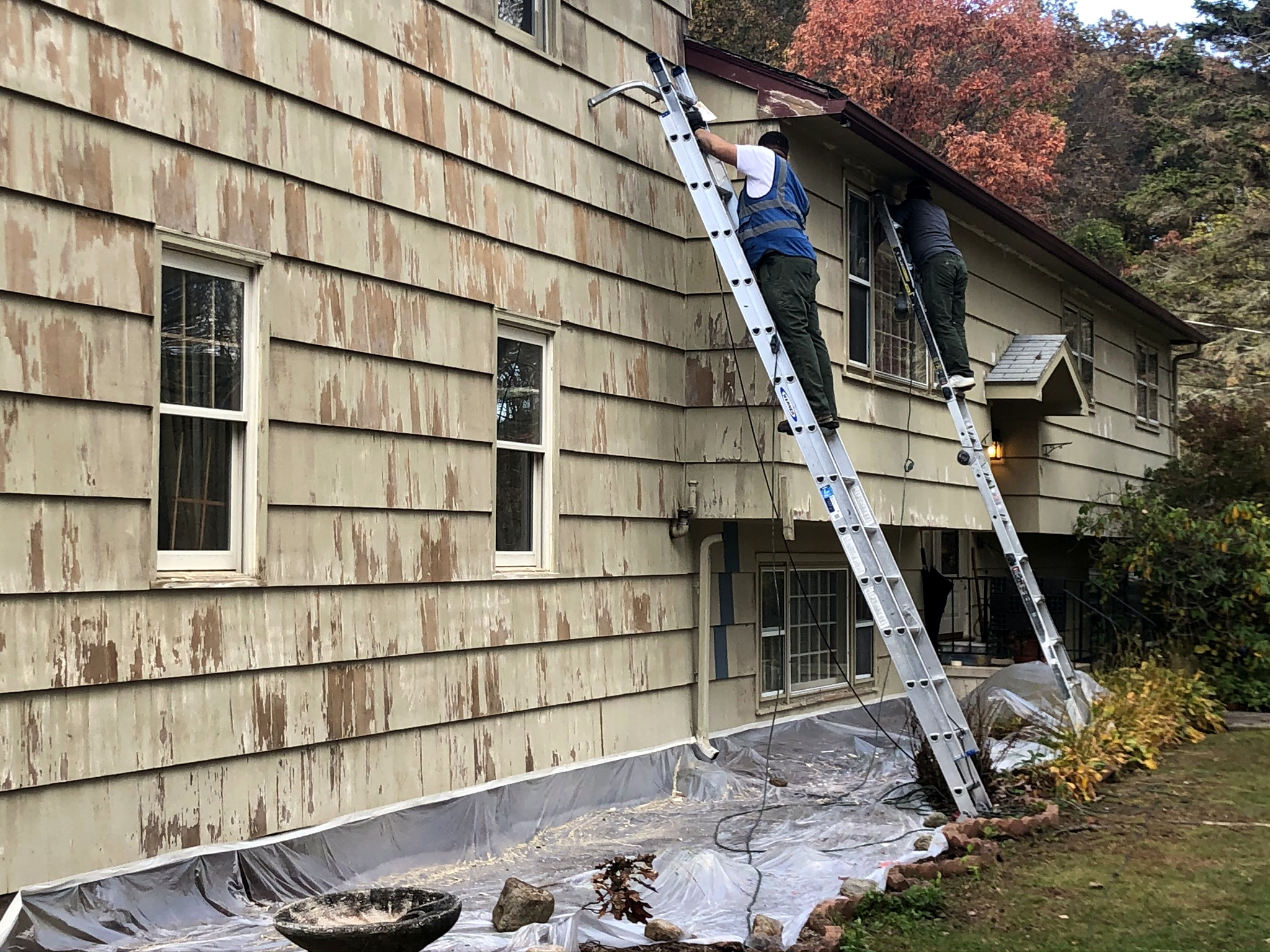
- When paint fails on cedar, it fails dramatically — large sheets of film pull off and you can see the bare wood beneath. Recoating means scraping, sanding, and priming all the bare areas.
- Cedar shake homes that have been painted look "harder" than the natural-finish original; we've had clients regret going to paint within one cycle.
Maintenance schedule for restored cedar
| Year | Task |
|---|---|
| Year 1 | Walk the house in spring. Check for any premature shingle failure — covered under our warranty if attributable to our prep. |
| Year 2–3 | Soft wash to remove mildew. Apply maintenance coat on south & west elevations only if visible fade. |
| Year 5 | Full inspection. Spot-replace any failed shingles. Light freshen-up coat where needed. |
| Year 7–8 | Full restain — all elevations. This is the next major service event. |
Real example: Greenwich shore home, 2018
A coastal Greenwich home with full cedar shake had been "painted white" in 2010 by a low-bid crew. By 2018 the paint was peeling in sheets across all four elevations. The homeowner thought he needed full replacement. We pulled a dozen shingles in non-visible spots — sheathing was sound, building paper intact. We did a full strip-and-restain over a 3-week window: pressure wash, complete chemical strip of the failing paint, full sand to bare cedar, two coats of Sikkens semi-transparent. The home is approaching its 8-year mark this summer and only needs a maintenance coat on the south elevation.
Total cost: $24,000. Replacement quote at the time: $58,000. The $34,000 saved went into a kitchen renovation.
What our crew brings to a cedar project
- 22+ years of cedar-specific experience across CT & NY.
- Dedicated cedar prep workflow with moisture metering.
- Sikkens-certified application — we don't subcontract stain work.
- Carpentry crew on the same job — we handle shingle replacement, not just stain.
- Written warranty on workmanship across the full project.
See real cedar work on our exterior gallery or carpentry showcase.
Need a real cedar diagnosis?
Free on-site assessment of your cedar shake. We'll tell you honestly: restore or replace, and exactly what each option costs.
Request My Estimate →Frequently asked questions
Should I stain or paint cedar shake?
For natural-look cedar shake, stain almost always wins. Stain penetrates the wood instead of forming a film, so it weathers gracefully and never peels. Paint forms a film that fails dramatically once moisture gets behind it. We use Sikkens for stain and only recommend paint on cedar that has already been painted.
How long does cedar shake last in Connecticut?
With proper maintenance — restained every 5–8 years and rotted shingles spot-replaced — cedar shake can last 50–80 years in CT. Without maintenance, expect 15–25 years before widespread replacement is required.
Can you paint over cedar shake that was previously stained?
Yes, but it is usually the wrong move. Once you put paint on cedar, you are in the paint cycle forever — you cannot go back to stain without complete sanding or replacement. We strongly recommend re-staining over previously stained cedar instead of painting it.